This is the single most common question I am asked in consultations. Patients arrive having seen both treatments online, often with the impression that composite bonding is simply the cheap version of veneers. That framing is misleading. They are different treatments that solve overlapping but distinct problems, and each one is the clearly correct answer in certain situations.
What follows is the comparison I actually go through with patients, organised by the factors that determine the decision rather than by marketing claims.
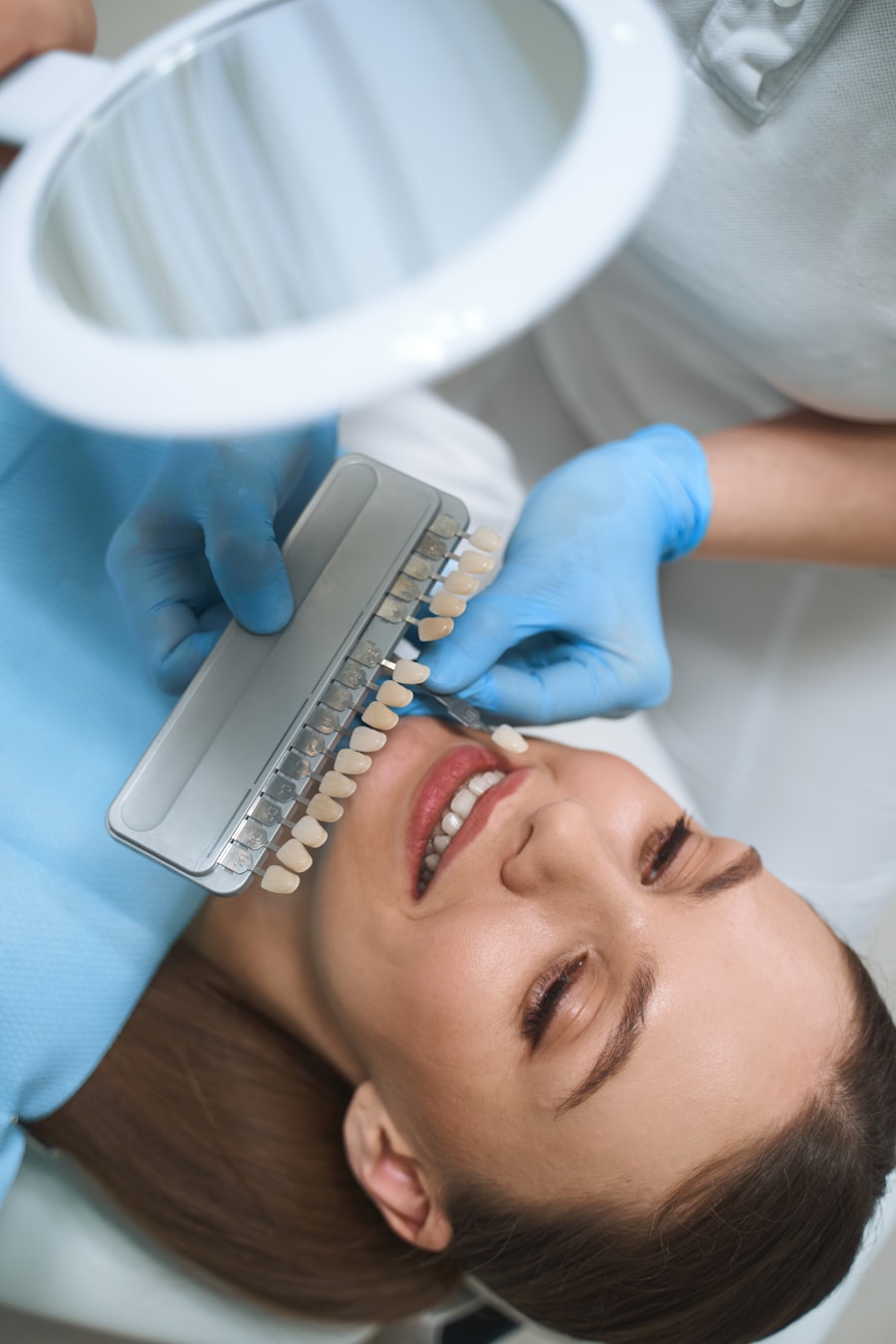
Shade selection — the stage where porcelain and composite plans diverge
The Short Answer
Choose composite bonding if your teeth are broadly well-aligned, the corrections needed are small — chipped edges, minor gaps, slightly worn incisal edges, mild shape irregularities — and you want a result today without permanently altering your teeth.
Choose porcelain veneers if you need a substantial change in colour, shape or apparent alignment, if the teeth are already heavily restored or discoloured internally, or if you want the longest-lasting and most stain-resistant result and accept that enamel reduction is part of the price.
If your teeth are structurally compromised rather than merely imperfect — large old fillings, root-treated teeth, significant fracture — neither is the right answer and you should be looking at dental crowns instead.
Tooth Preparation and Reversibility
This is the most important difference, and the one most often glossed over.
Composite bonding
Additive composite bonding is applied directly onto the existing enamel surface after light etching and application of a bonding agent. In genuinely additive cases no drilling is performed at all. The enamel remains intact underneath, and the composite can be removed if you change your mind. This makes bonding the appropriate choice for younger patients, for anyone uncertain about committing, and for cases where the underlying teeth are healthy and simply need refining.
Porcelain veneers
Conventional porcelain veneers require approximately 0.3–0.7mm of enamel reduction across the visible surface, extending slightly beyond the contact points. This creates space for the ceramic so the finished tooth is not bulky, and it produces a bonding surface with predictable geometry. Enamel does not regenerate. Once prepared, a tooth will require a veneer or crown for the rest of its life. Minimal-preparation and no-preparation veneer designs exist and are genuinely useful in selected cases — typically small or retroclined teeth — but they are not universally applicable, and a veneer placed on an unprepared tooth that needed preparation will look thick and unnatural.
The honest framing is this: bonding borrows, veneers commit. Neither is wrong, but the commitment should be a decision you make deliberately.
Longevity and What Actually Fails
Porcelain veneers have the stronger long-term evidence base. Systematic review data, including the widely cited review by Peumans and colleagues (2004), reports high survival rates for bonded porcelain veneers over ten years, provided the bond is made predominantly to enamel rather than dentine. In practice, well-planned veneers frequently serve 10–15 years or longer. When they fail, the usual causes are debonding, fracture through the ceramic, or marginal caries at the gum line rather than gradual deterioration.
Composite bonding has a shorter service life. Expect roughly 5–7 years before significant refurbishment or replacement is needed, and rather less than that in patients who grind. Composite rarely fails catastrophically; instead it degrades gradually — the incisal edge chips, the margin picks up a dark line, the surface loses its polish and starts to look dull against adjacent natural enamel. The advantage of this failure mode is that it is repairable chairside in a single appointment, often without touching the rest of the restoration.
The bruxism factor
If you grind or clench, this changes the calculation for both options. Composite chips under parafunctional load; porcelain fractures under it, and a fractured veneer generally cannot be repaired and must be remade. Neither treatment should be placed in an unmanaged grinder. A protective night guard is not optional in these cases, and if there is an underlying joint or muscle problem it should be addressed first — see the article on TMJ and temporomandibular disorders.
Staining, Colour and Maintenance
Glazed porcelain is essentially non-porous. It does not absorb chromogens from coffee, tea, red wine or tobacco, and it holds its colour for the life of the restoration. The trade-off is that porcelain also cannot be whitened — its shade is fixed at the point of manufacture, which is why any whitening of the remaining natural teeth must be completed before the veneer shade is selected.
Composite resin is porous by comparison and does absorb stain. Realistically it needs professional polishing every 6–12 months to maintain its appearance, and heavy coffee, tea, red wine or tobacco use will accelerate discolouration noticeably. Composite has the compensating advantage of being adjustable — the shade can be modified, and additions can be made later without remaking anything.
If you are a heavy coffee or red wine drinker and not inclined to attend regular polishing appointments, porcelain is the more realistic choice regardless of budget. If you are planning to whiten your natural teeth at some point, sequence that first.
Cost — and Lifetime Cost
In the UK, composite bonding typically runs £250–£450 per tooth and porcelain veneers £800–£1,200 per tooth. On a six-tooth upper smile that is roughly £1,500–£2,700 for bonding against £4,800–£7,200 for veneers, which is why bonding is so often presented as the budget option.
The lifetime picture is different. Composite at seven-year intervals replaced twice over fifteen years approaches the cost of a single set of veneers that lasted the same period, before accounting for the polishing appointments in between. Bonding is genuinely cheaper to start and genuinely more affordable if your budget is constrained now — but it is not necessarily cheaper over twenty years, and presenting it that way to patients is not accurate.
Treatment in Antalya changes the arithmetic for porcelain specifically, because the laboratory and clinical cost component is where the saving sits. For a detailed breakdown including travel costs, see dental treatment costs: UK vs Turkey.

Composite bonding — conservative correction with no enamel reduction
Time and Number of Appointments
Composite bonding is a single-visit treatment. The resin is sculpted directly in the mouth, cured, shaped and polished in one appointment, typically two to three hours for a full upper smile. There is no laboratory stage and no temporary phase. You leave with the finished result.
Porcelain veneers require at least two visits separated by laboratory fabrication. The first appointment covers preparation, digital scanning or impressions, shade selection and provisional veneers; the second covers try-in, adjustment and definitive bonding. For UK patients treated in Antalya this is structured as a single trip of approximately 5–7 days, with the online consultation and planning completed beforehand.
Which Is Right For Your Case
Composite bonding is likely the better choice if
- Your teeth are reasonably well-aligned and the changes needed are minor
- You want to keep the option of changing your mind
- You are under 30, or the teeth are otherwise young and unrestored
- You are correcting chipped or worn incisal edges
- You want to trial a new shape before committing to porcelain
- Budget is a primary constraint right now
Porcelain veneers are likely the better choice if
- You need a significant colour change, particularly with internal discolouration such as tetracycline staining
- Tooth shape or apparent alignment needs substantial correction
- The teeth already carry large composite restorations
- You drink coffee, tea or red wine heavily, or smoke
- You want the longest-lasting result and are prepared for the enamel commitment
- Previous bonding has failed repeatedly
Combining the Two
These are not mutually exclusive, and in practice the best plans often use both. A frequent approach is porcelain veneers on the upper front teeth that dominate the smile, with composite bonding on the adjacent premolars for smaller shape and edge corrections. Composite is also extremely useful diagnostically: a direct mock-up lets you see and live with a proposed shape before any enamel is touched, which is the single best safeguard against an irreversible decision you regret.
Detailed treatment-specific information is available in the dedicated articles on porcelain veneers and composite bonding, and completed cases of both are shown in the before and after gallery.
Frequently Asked Questions
Is composite bonding cheaper than veneers?
Yes at the point of treatment — roughly £250–£450 per tooth against £800–£1,200 for porcelain. Over fifteen to twenty years the gap narrows considerably, because composite needs replacing every 5–7 years and regular polishing in between.
Is composite bonding really reversible?
Genuinely additive bonding, placed without drilling, is reversible — the resin sits on intact enamel and can be removed. Be aware that not all bonding is additive; if any enamel is reduced to create space, that portion is not reversible. Ask specifically whether your case involves preparation.
Will composite bonding stain?
Yes, gradually. Coffee, tea, red wine and tobacco are the main culprits. Professional polishing every 6–12 months keeps it looking fresh. Porcelain does not stain in the same way, which is often the deciding factor for heavy coffee and wine drinkers.
Can I have veneers if I grind my teeth?
Yes, but only with the grinding managed. A night guard is essential, and any underlying temporomandibular problem should be assessed first. A fractured porcelain veneer cannot usually be repaired and must be remade, so this is not a corner worth cutting.
Can I whiten my teeth after having veneers or bonding?
Whitening will not change the shade of porcelain or composite — only the natural teeth around them, which will then no longer match. Any whitening must be completed before the restoration shade is chosen. Composite can at least be re-polished or replaced to match; porcelain cannot.
Which looks more natural?
Both can look excellent and both can look artificial — the outcome depends far more on the clinician's shape and shade control than on the material. Porcelain has an advantage in translucency and surface lustre, particularly at the incisal edge. Composite in skilled hands is very close and has the advantage of being adjustable if the first result is not quite right.