Porcelain veneers are custom-fabricated, ultra-thin ceramic restorations applied to the labial (front) surfaces of teeth to correct a range of aesthetic concerns: intrinsic discolouration that cannot be resolved by whitening, chips and fractures, diastema, peg-shaped laterals, irregular tooth proportions, and mild positional irregularities. As a prosthodontist, I approach veneer treatment with the same precision and evidence base that underpins restorative and implant work — careful patient selection, a meticulous diagnostic phase including Digital Smile Design, and a bonding protocol founded on adhesive dentistry science.
Porcelain veneer consultation — Dr. Dt. Tuba Akcakus Battal
For patients considering a smile makeover in the UK or Turkey, porcelain veneers delivered by a prosthodontic specialist offer a significant step up in precision compared to cosmetic dental treatments performed without specialist training. The aesthetic outcome, the quality of the ceramic, the precision of the preparation, and the integrity of the adhesive bond all directly affect how your veneers look, function, and endure.
Types of Dental Veneers
Feldspathic Porcelain Veneers
Feldspathic porcelain — the original veneer ceramic — is hand-layered by a skilled dental technician in increments of translucent powder slurry, fired repeatedly in a porcelain furnace to achieve remarkable depth and translucency. These veneers are fabricated at thicknesses of 0.3–0.5mm — barely thicker than a contact lens — and offer the most lifelike optical properties of any veneer material, mimicking the enamel's natural light-scattering behaviour. Their relative fragility compared to monolithic ceramics means they require precise preparation and bonding, and they are ideally suited to patients who prioritise maximum optical naturalness. Peumans et al.'s systematic review (2004) reported a 10-year survival rate of 93.5% for feldspathic porcelain veneers under appropriate clinical conditions.
IPS e.max Lithium Disilicate
IPS e.max (Ivoclar Vivadent) is a press-ceramic or CAD/CAM-milled lithium disilicate material offering a flexural strength of approximately 400 MPa — substantially stronger than feldspathic porcelain — with excellent translucency and shade-matching capability. This combination of strength and aesthetics makes IPS e.max the most widely used ceramic for veneers in contemporary practice. It accommodates a thinner preparation than zirconia (which is too opaque for veneers), while withstanding normal occlusal stresses better than pure feldspathic ceramics. Both pressed and milled (CAD/CAM) fabrication pathways are available, with pressed e.max generally offering slightly superior marginal fit and internal characterisation.
Composite Veneers
Composite resin veneers — fabricated either directly (chair-side in a single visit) or indirectly (laboratory-made) — are a more conservative and cost-accessible alternative. Direct composite veneers can be completed in one appointment with no preparation, but are more susceptible to staining, surface wear, and fracture than ceramic options. For a detailed comparison, see our composite bonding page. The choice between composite and porcelain veneers depends on the patient's budget, the degree of aesthetic correction required, the presence of parafunctional habits, and the patient's willingness to accept a slightly less durable restoration in exchange for reversibility.
The Veneer Preparation Process
Digital Smile Design (DSD)
Modern veneer treatment begins with Digital Smile Design — a workflow that uses facial photographs, dental photographs, and video to plan the ideal tooth shape, proportions, and position before any preparation takes place. DSD software allows the clinician to overlay proposed tooth forms onto the patient's smile photograph, creating a preview of the expected aesthetic outcome. This design is then transferred to a wax mock-up on study models, which can be temporarily placed on the teeth as a trial smile. This diagnostic phase is not merely a communication tool — it directly informs the preparation guide and the technician's characterisation targets, ensuring that the final porcelain veneers are a deliberate, measurable realisation of the planned aesthetic, not an improvisation.
Enamel Reduction and Temporaries
For conventional veneers, a thin layer of enamel — typically 0.3–0.5mm — is removed from the labial tooth surface using a diamond bur under water irrigation. This creates space for the veneer without increasing the overall tooth profile. Preparation is ideally kept entirely within enamel — the highly mineralised outer layer — to maximise adhesive bond strength; enamel-to-enamel bonding is significantly more reliable than dentine-to-resin bonding. In patients with sufficient labial enamel volume, no-prep veneers (removing no tooth structure) or ultra-minimal prep veneers are possible, though their indication is limited to specific clinical presentations. Following preparation, temporary composite veneers are placed to protect the teeth and allow the patient to evaluate the planned aesthetics and phonetics before committing to the final result.
Bonding Protocol: Phosphoric Acid Etch, Silane Coupling, Dual-Cure Resin
The adhesive bonding of porcelain veneers is one of the most technique-sensitive procedures in cosmetic dentistry, and its precision directly determines the longevity of the result. The internal ceramic surface is etched with 5–9% hydrofluoric acid to create micro-retentive surface irregularities, then treated with a silane coupling agent (e.g. Monobond Plus, Ivoclar Vivadent) which forms a covalent chemical bond between the ceramic and the resin. The prepared tooth surface is etched with 37% phosphoric acid to expose the enamel prisms, followed by an unfilled bonding agent. The veneer is then seated with a dual-cure (light-activated and self-cure) composite resin luting cement, which provides both an immediate working window during seating and thorough polymerisation beneath the opaque ceramic. Shade choice of the luting resin influences the final colour of translucent ceramics, so shade selection at this stage requires care.
Clinical Evidence
The long-term clinical performance of porcelain veneers is well documented. The landmark systematic review by Peumans et al. (2004) reported 10-year survival rates of 93.5% for feldspathic porcelain veneers, with the most common failure modes being ceramic fracture and debonding. Subsequent studies on IPS e.max veneers report comparable or superior survival, with some series reporting 10-year survival above 95%. The main predictors of veneer longevity are: sufficient enamel for bonding (the single most important factor), absence of parafunctional loading (bruxism is the leading cause of veneer fracture), appropriate material selection for the clinical indication, and meticulous adhesive protocol.
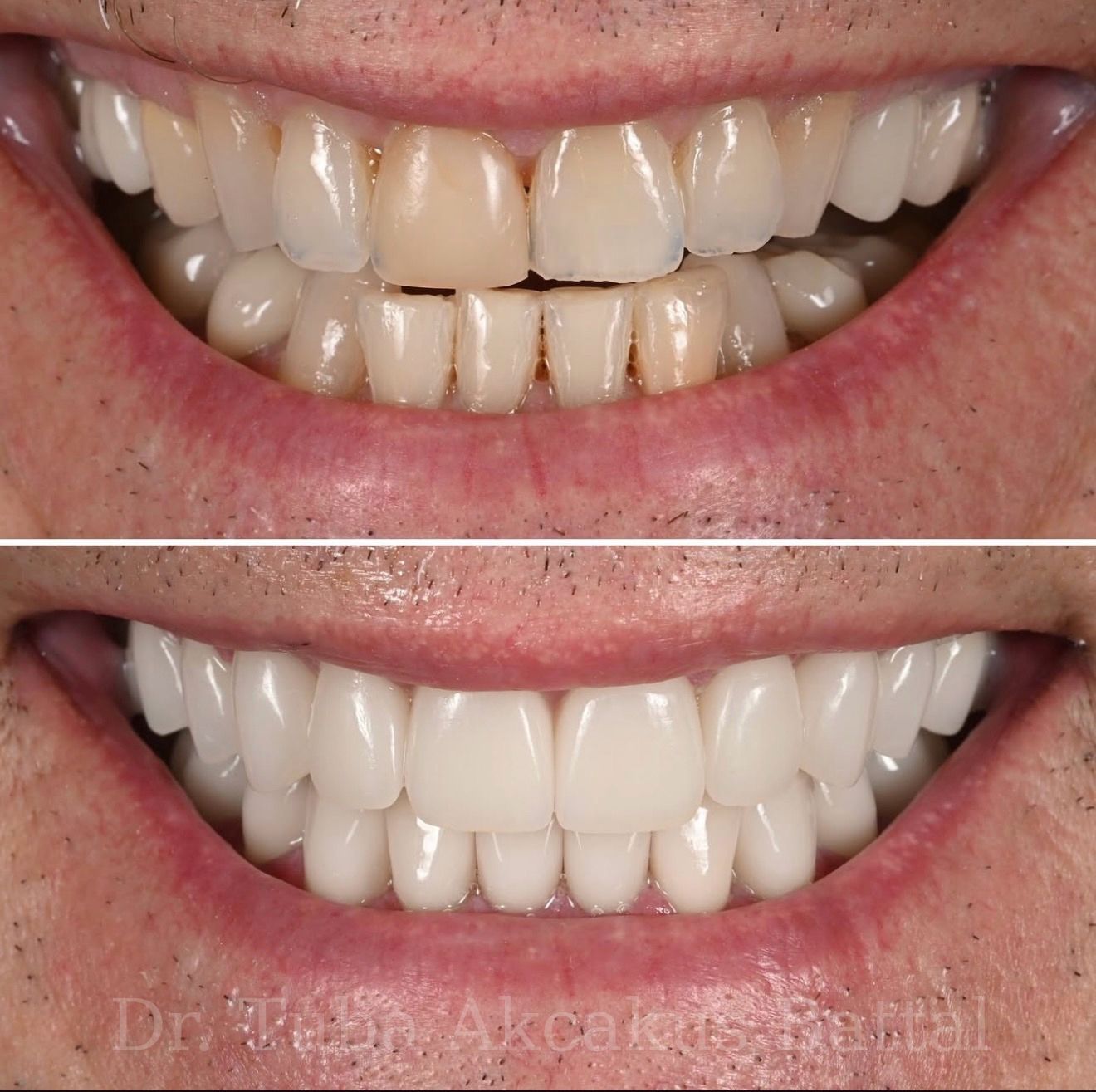
Porcelain veneer result — full smile makeover, natural translucency
Who Is a Suitable Candidate?
Veneers are suitable for patients with aesthetically unsatisfactory anterior teeth who have sufficient enamel, no active periodontal disease, and controlled occlusion. Typical indications include:
- Intrinsic discolouration: fluorosis, tetracycline staining, non-vital tooth darkening
- Chipped or fractured anterior teeth
- Diastema closure (spaces between teeth)
- Peg-shaped lateral incisors
- Mild-to-moderate malalignment where orthodontics has been declined
- Tooth wear with sufficient remaining enamel
Contraindications include active bruxism without a protective nightguard protocol, severe tooth crowding, insufficient remaining enamel (which compromises bond strength), and unrealistic patient expectations. Patients with parafunctional habits can often still receive veneers if a well-fitted occlusal nightguard is prescribed and worn consistently.
Veneer Longevity and Care
With appropriate care, feldspathic and IPS e.max veneers can remain in excellent condition for 10–20 years. Daily oral hygiene with a soft-bristle toothbrush and non-abrasive toothpaste preserves the glaze and marginal integrity of the ceramic. Patients should avoid biting directly on hard objects (ice, hard sweets, fingernails) with veneered teeth, as ceramic is brittle under point-loading stress despite its high flexural strength. A nightguard is strongly recommended for bruxists and heavy clenchers. When a veneer does fail — typically through fracture or debonding — it can usually be replaced with a new veneer without further tooth preparation, as the original reduction space remains.
Frequently Asked Questions
Are porcelain veneers permanent?
Veneers involve an irreversible enamel reduction — the prepared tooth always requires a covering restoration going forward. However, veneers are not "permanent" in the sense that they last indefinitely: they will eventually need replacement, typically after 10–20 years depending on the material and how well they are maintained. When they are replaced, the process generally requires no further tooth reduction, as the original preparation space accommodates the new veneer.
Do veneers damage teeth?
Minimal-preparation veneers remove only 0.3–0.5mm of enamel — a small and carefully controlled amount. This is significantly less than a dental crown preparation (which removes 1.5–2mm circumferentially). The remaining enamel is not weakened in a clinically meaningful way and provides a strong adhesive substrate. No-prep veneers, suitable for specific cases, require no tooth reduction at all. When placed by a skilled prosthodontist using correct preparation and bonding protocols, veneers do not harm the underlying tooth structure.
What do veneers cost in the UK vs Turkey?
In the UK, IPS e.max or feldspathic porcelain veneers typically cost £700–£1,500 per tooth. A full smile of 8–10 veneers therefore represents a significant investment of £7,000–£15,000. In Antalya, the same quality ceramic, fabricated by an experienced dental technician, is available at 50–60% of UK pricing. Our Antalya partner clinic uses premium ceramic materials and employs skilled ceramists to ensure laboratory-standard results at a considerably lower total cost.
How long does the veneer process take?
From initial consultation to final delivery, the full veneer process typically takes 2–3 weeks. The preparation appointment (where enamel reduction and temporaries are completed) takes 1–2 hours. The laboratory fabrication phase takes approximately 10–14 days. The bonding appointment takes 1–2 hours for seating, shade-checking, and final finishing. Patients undergoing treatment in Antalya typically schedule two visits approximately two weeks apart, or may opt for an extended single trip.

Porcelain veneer — natural aesthetics and symmetry