All-on-6 dental implants represent a complete arch rehabilitation technique in which six titanium implant fixtures are placed into the jawbone to support a fixed, non-removable prosthetic bridge. For patients who are fully edentulous — or who are losing their remaining teeth — this approach eliminates the functional and psychological burden of traditional removable dentures, restoring natural biting force, speech clarity, and aesthetic confidence. As a specialist in prosthodontics with clinical exposure across the UK and at our partner clinic in Antalya, Turkey, I work with patients to determine whether All-on-6 is the most appropriate treatment pathway based on their bone anatomy, systemic health, and aesthetic goals.
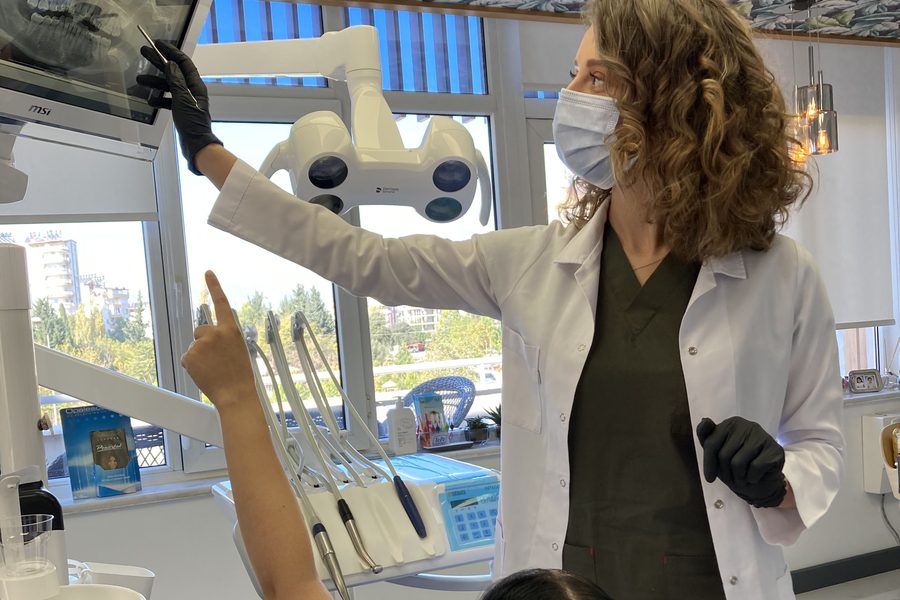
All-on-6 treatment planning — X-ray review with Dr. Dt. Tuba
The "all-on" concept — anchoring a full arch of teeth on a small number of precisely placed implants — was pioneered in the late 1990s and early 2000s, building on Per-Ingvar Brånemark's foundational research into titanium osseointegration. All-on-6 extends the original four-implant protocol by adding two additional posterior fixtures, which improves stress distribution across the prosthetic bridge and reduces the risk of cantilever-related mechanical complications.
What Is the All-on-6 Procedure?
The All-on-6 treatment involves two primary stages: the surgical placement of the implants and the fabrication and delivery of the prosthetic bridge. Both stages require careful pre-surgical planning using cone-beam computed tomography (CBCT) to map bone volume, density, and the positions of critical anatomical structures such as the inferior alveolar nerve in the mandible and the maxillary sinuses in the upper jaw.
The Implant Placement
Under local anaesthesia — with conscious sedation available for anxious patients — six titanium implant fixtures are placed into the jawbone following a pre-planned surgical guide. In the maxilla (upper jaw), the posterior implants are often placed at a slight mesial angulation to avoid the sinus cavities and maximise engagement with denser anterior bone. In the mandible, the implants are typically placed vertically, with posterior fixtures positioned anterior to the mental foramen. The use of surgical guides, manufactured from the pre-operative CBCT and digital planning software, ensures millimetre-level accuracy in fixture placement. Primary implant stability — measured by insertion torque values typically exceeding 35 Ncm — is assessed at the time of surgery and determines whether immediate provisional loading is possible.
The Fixed Bridge
Once implants are placed and primary stability is confirmed, a provisional prosthetic bridge is attached, allowing the patient to leave with a full set of functional teeth the same day or within 24–48 hours. This provisional bridge is typically fabricated from PMMA acrylic resin and is designed to reduce occlusal loading on the healing implants. After a healing period of 4–6 months — during which osseointegration consolidates — a definitive bridge is fabricated. Material options for the final prosthesis include full-contour monolithic zirconia (the current gold standard for longevity), zirconia with a porcelain veneering layer for enhanced aesthetics, or hybrid acrylic-titanium frameworks. See our guide to dental crown materials for a detailed comparison.
Clinical Evidence and Long-Term Outcomes
The biological foundation of All-on-6 rests on osseointegration — the direct structural and functional connection between living bone and the implant surface. Brånemark's original longitudinal studies, later confirmed by systematic reviews including Pjetursson et al. (2012) and the ITI Consensus statements, consistently report implant survival rates exceeding 95% at 10 years for well-selected patients. The posterior angulated implants used in some All-on-6 configurations have been validated in independent clinical studies, showing comparable survival rates to axially placed fixtures when surgical and prosthetic protocols are adhered to. Long-term prosthetic complications — such as acrylic fracture or screw loosening — are significantly reduced with full-contour zirconia frameworks and titanium screw-retained bridges designed with passive fit.
Patient-reported outcomes (PROs) consistently demonstrate dramatic improvements in oral health-related quality of life (OHRQoL) following full-arch implant rehabilitation. Studies using the OHIP-14 instrument report statistically significant reductions in functional limitation, psychological disability, and social disability scores compared to pre-treatment denture wearing.
All-on-6 vs All-on-4: Key Differences
Both protocols achieve full-arch fixed rehabilitation, but they differ in engineering rationale and patient suitability. All-on-4 uses four implants, with the two posterior implants placed at a 30–45° angulation to maximise bone contact and enable a longer cantilever span without bone grafting. All-on-6 adds two additional implants, typically placed vertically in the posterior regions when sufficient bone is present. The clinical advantages of All-on-6 include reduced cantilever length, lower prosthetic stress concentrations, and potentially improved outcomes in patients with parafunctional habits such as bruxism. All-on-6 is generally preferred when bone volume allows, particularly in the mandible where denser cortical bone supports reliable posterior placement.
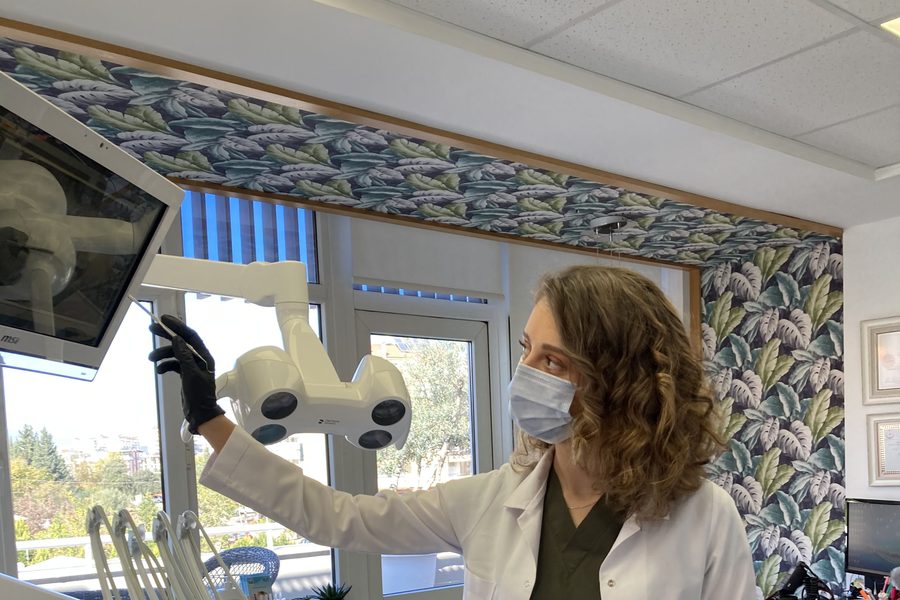
Dr. Dt. Tuba Akcakus Battal reviewing implant X-ray — All-on-6 treatment planning
Suitable Candidates and Bone Assessment
A thorough diagnostic work-up is essential before committing to any full-arch implant protocol. The primary imaging tool is CBCT, which provides three-dimensional data on bone height, width, and density — typically classified using the Misch bone density scale (D1–D4), where D1 and D2 cortical bone offer the most predictable osseointegration. Candidates for All-on-6 include patients who are fully edentulous, those with multiple failing or non-restorable teeth, and individuals currently wearing complete or partial dentures who seek a fixed alternative.
- Adequate bone volume in the anterior and posterior regions (ideally 10mm height, 6mm width)
- No uncontrolled systemic conditions (well-managed diabetes, cardiovascular disease, and osteoporosis are generally acceptable)
- Non-smoker or willing to stop smoking perioperatively (smoking significantly increases implant failure risk)
- Realistic expectations and commitment to long-term maintenance
In cases of ridge resorption — particularly in the posterior maxilla — a sinus floor elevation (sinus lift) or guided bone regeneration (GBR) procedure may be recommended prior to or concurrent with implant placement. These augmentation procedures add healing time but meaningfully expand the pool of suitable candidates.
Materials: Zirconia vs Acrylic Bridges
The choice of prosthetic material significantly influences the durability, aesthetics, and long-term maintenance requirements of your All-on-6 restoration. Full-contour zirconia (Y-TZP, yttria-stabilised tetragonal zirconia polycrystal) offers flexural strength in the range of 900–1200 MPa and excellent biocompatibility, making it the preferred material for full-arch fixed bridges. It resists fracture, does not absorb stains, and requires minimal adjustments over time. Hybrid acrylic-titanium frameworks are lighter and more economical, but the acrylic resin component is susceptible to wear and chipping and will typically require renewal or repair within 5–8 years. For patients prioritising longevity, zirconia full-arch bridges represent the superior long-term investment.
The Treatment Journey: UK Consultation to Antalya Surgery
My practice is structured to support UK-based patients through every stage of the treatment process. An initial consultation — available online — involves a comprehensive assessment of your dental and medical history, current radiographs or CBCT scans if available, and a discussion of your aesthetic and functional goals. A detailed treatment plan and cost estimate are provided at this stage, with no obligation to proceed. For patients who proceed, the surgical component takes place at our partner clinic in Antalya, Turkey, under the care of an experienced implant surgical team. Antalya offers the same international-standard implant systems (Nobel Biocare, Straumann, Osstem) at considerably lower overall cost due to the economic differential between the UK and Turkey. Post-surgical follow-up is coordinated with your UK-based care to ensure continuity and monitoring of healing progress.
Frequently Asked Questions
How long do All-on-6 implants last?
With proper oral hygiene, professional maintenance, and avoidance of heavy parafunctional loading, All-on-6 implant fixtures can remain functional for 20 years or more. Osseointegration success rates consistently exceed 95% at the 10-year mark across multiple systematic reviews. The prosthetic bridge — particularly if made from full-contour zirconia — has an expected clinical lifespan of 15–20 years, though individual variables such as bruxism, hygiene habits, and occlusal loading affect longevity.
Is the All-on-6 procedure painful?
All-on-6 surgery is performed under local anaesthesia with sedation options available for anxious patients. The procedure itself is not painful; patients typically feel pressure and movement rather than pain. Post-operative discomfort — swelling, bruising, and tenderness — peaks at 48–72 hours and is effectively managed with prescribed non-steroidal anti-inflammatory drugs (NSAIDs) and paracetamol. Most patients describe their recovery as more manageable than anticipated.
Can I get All-on-6 if I have bone loss?
Moderate bone loss does not automatically disqualify you from All-on-6. CBCT assessment is essential to quantify the available bone volume and density. In many cases, the anterior jaw — which resorbs more slowly than the posterior regions — retains sufficient bone for reliable implant placement even after years of edentulism. Where posterior bone volume is inadequate, a sinus lift in the upper jaw or angled implant positioning can often compensate. Severe, advanced resorption may require staged bone augmentation procedures before implant placement.
What is the cost of All-on-6 in Turkey vs the UK?
In the UK, full-arch All-on-6 treatment typically ranges from £18,000 to £30,000 per arch depending on the clinic, the implant system used, and whether bone grafting is required. At our partner clinic in Antalya, the same quality of treatment — using premium implant systems and full-contour zirconia prosthetics — is available at 50–65% lower cost. When flight and accommodation costs are factored in, patients typically achieve substantial savings even after including travel. Our team provides transparent, itemised cost estimates at the initial consultation stage so you can make a fully informed decision.
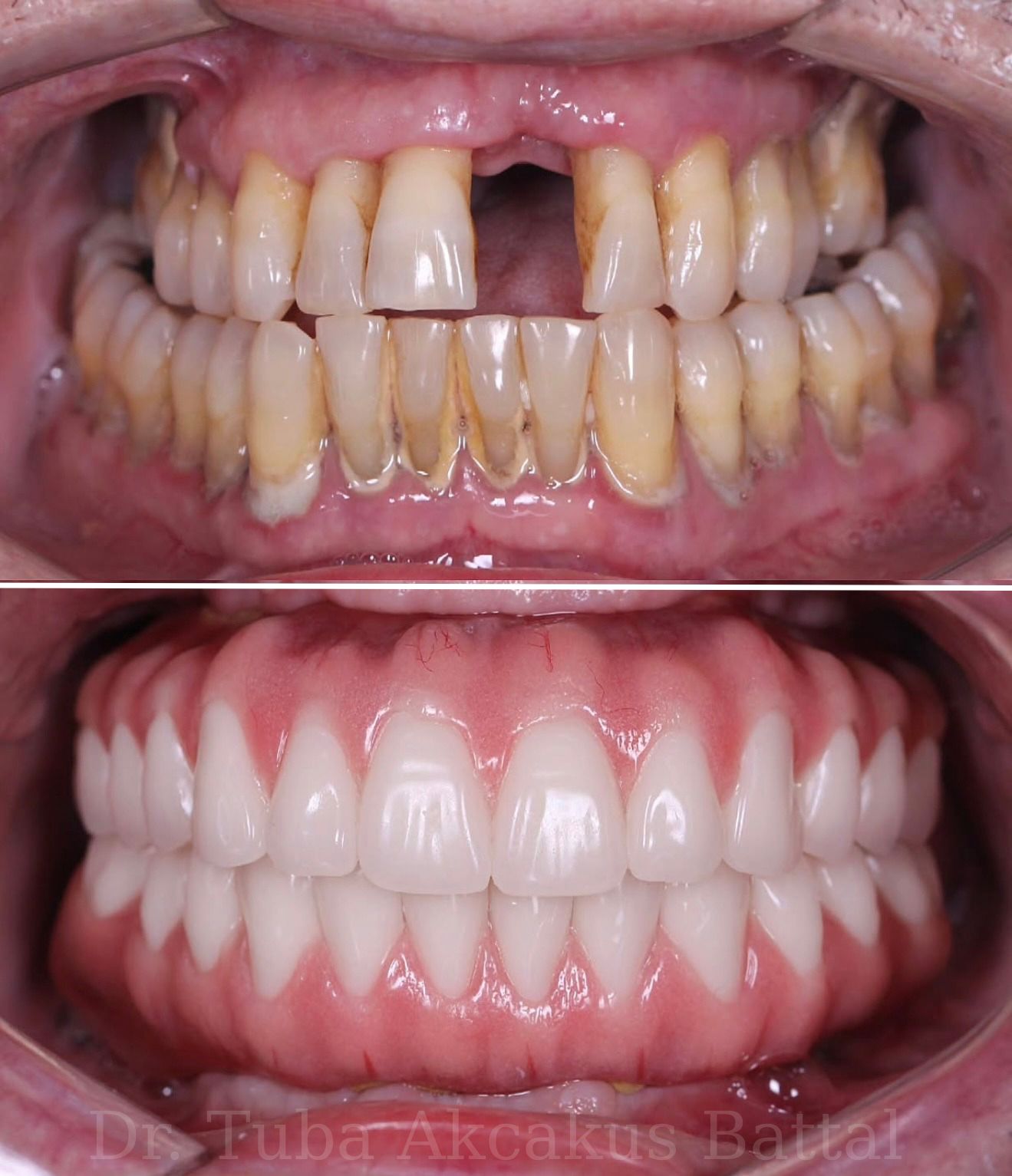
All-on-6 clinical result — full arch restored, confident smile