A dental implant is a small titanium screw-shaped fixture surgically placed into the jawbone to serve as an artificial tooth root. Once the implant integrates with the surrounding bone — a process known as osseointegration — it provides a stable, permanent foundation for a crown, bridge, or overdenture. For patients in the UK and those seeking treatment in Turkey, dental implants represent the most anatomically faithful method of replacing one or more missing teeth, preserving the integrity of the surrounding bone and avoiding the compromises inherent in conventional dentures and bridges.
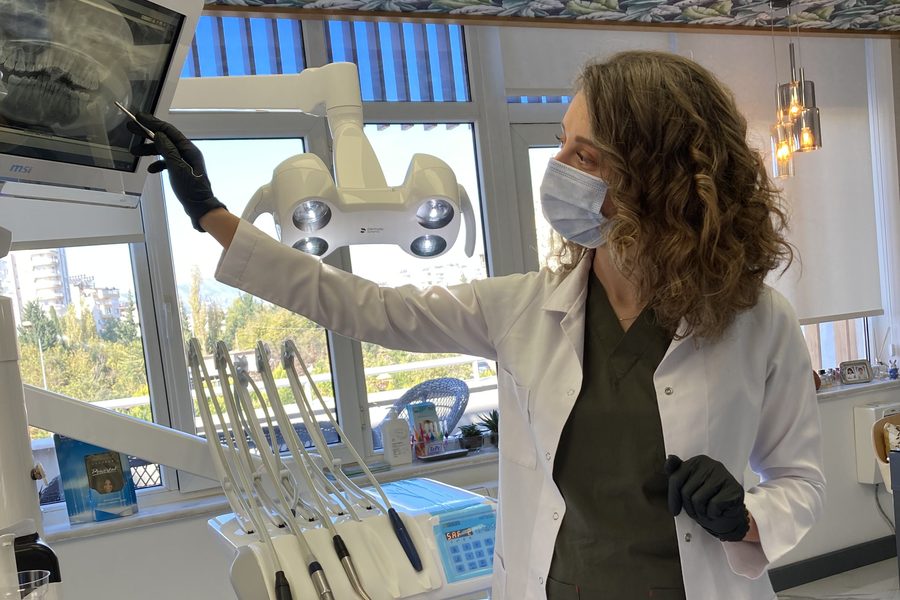
Implant treatment planning — X-ray review with Dr. Dt. Tuba
As a specialist prosthodontist, I oversee every stage of the implant journey — from the initial diagnostic consultation and treatment planning in the UK, through surgical coordination at our partner clinic in Antalya, to the final prosthetic delivery and long-term maintenance. Whether you are missing a single tooth, several teeth, or require full-arch rehabilitation, implant dentistry offers a solution calibrated to your specific anatomy, functional needs, and aesthetic goals.
How Dental Implants Work
Osseointegration: The Biological Process
The foundational science of modern dental implantology is osseointegration — the direct structural and functional union between living bone tissue and the surface of a titanium implant. The term was coined by Swedish orthopaedic surgeon Per-Ingvar Brånemark, who in 1952 accidentally discovered that titanium chambers placed in rabbit femoral bone became irreversibly incorporated into the surrounding tissue. In 1965, Brånemark placed the first titanium dental implant in a human patient; that patient retained the implant until his death 40 years later — a defining proof-of-concept that transformed implant dentistry into a predictable, evidence-based discipline.
Following placement, the implant surface — typically a micro-rough, sandblasted and acid-etched (SLA) or fluoride-modified surface — promotes rapid attachment of osteoblasts. Over 3–6 months, these bone-forming cells deposit new lamellar bone directly onto the implant surface without any fibrous tissue layer intervening. The result is a direct bone-to-metal union that withstands functional loading equivalent to natural tooth roots. This osseointegration period is why implant treatment — unlike some other restorative options — requires time before final restoration delivery.
The Implant Components: Fixture, Abutment, and Crown
A complete implant restoration consists of three parts working in concert. The fixture (or implant body) is the endosseous component — the titanium screw embedded in the bone. The abutment is a connecting element that protrudes above the gumline, providing the interface between the submerged fixture and the visible prosthetic crown. Abutments can be prefabricated in standard forms or custom-milled from titanium or zirconia for optimal emergence profile and aesthetics. The crown — the visible, tooth-coloured restoration — is fabricated to match the surrounding teeth in shape, shade, and occlusion, and attaches to the abutment via screw retention or cement. For a detailed guide to crown materials including zirconia and IPS e.max, see our dental crowns page.
Types of Implants
Dental implants are not a one-size-fits-all treatment. The appropriate configuration depends on how many teeth are missing and the quality of the remaining bone and adjacent dentition.
- Single tooth implant: One implant fixture supporting one crown. The ideal replacement for a single missing tooth — it does not require reducing adjacent healthy teeth (as a conventional bridge does) and preserves the bone architecture around the implant site.
- Multiple teeth implants: Two or more implants supporting individual crowns or an implant-supported bridge. Where several adjacent teeth are missing, an implant bridge using two or three fixtures to support four or five crowns is often more cost-effective than placing an implant for every missing tooth.
- Implant-retained overdenture: Two to four implants placed in the anterior jaw to anchor a removable overdenture. This improves stability and chewing efficiency dramatically compared to a conventional denture, while remaining a more economical option than a full-arch fixed bridge.
- Full-arch fixed rehabilitation: All-on-4 or All-on-6 protocols support a complete fixed bridge on four or six implants per arch. The most comprehensive implant solution for fully edentulous patients.
Clinical Evidence
The long-term clinical evidence base for dental implants is extensive and consistently positive. The landmark systematic review by Pjetursson et al. (2012), analysing data from 103 studies, reported 10-year survival rates exceeding 95% for single implant-supported crowns. Comparable results have been reported in numerous independent systematic reviews examining mandibular and maxillary implants across different bone types and patient populations. Implant-supported bridges and full-arch restorations report similarly high survival rates, with the majority of failures attributable to identifiable risk factors — principally smoking, uncontrolled systemic disease, and peri-implant infection. These findings make dental implants not merely an alternative to bridgework and dentures, but the biological and mechanical superior option in most clinical scenarios.
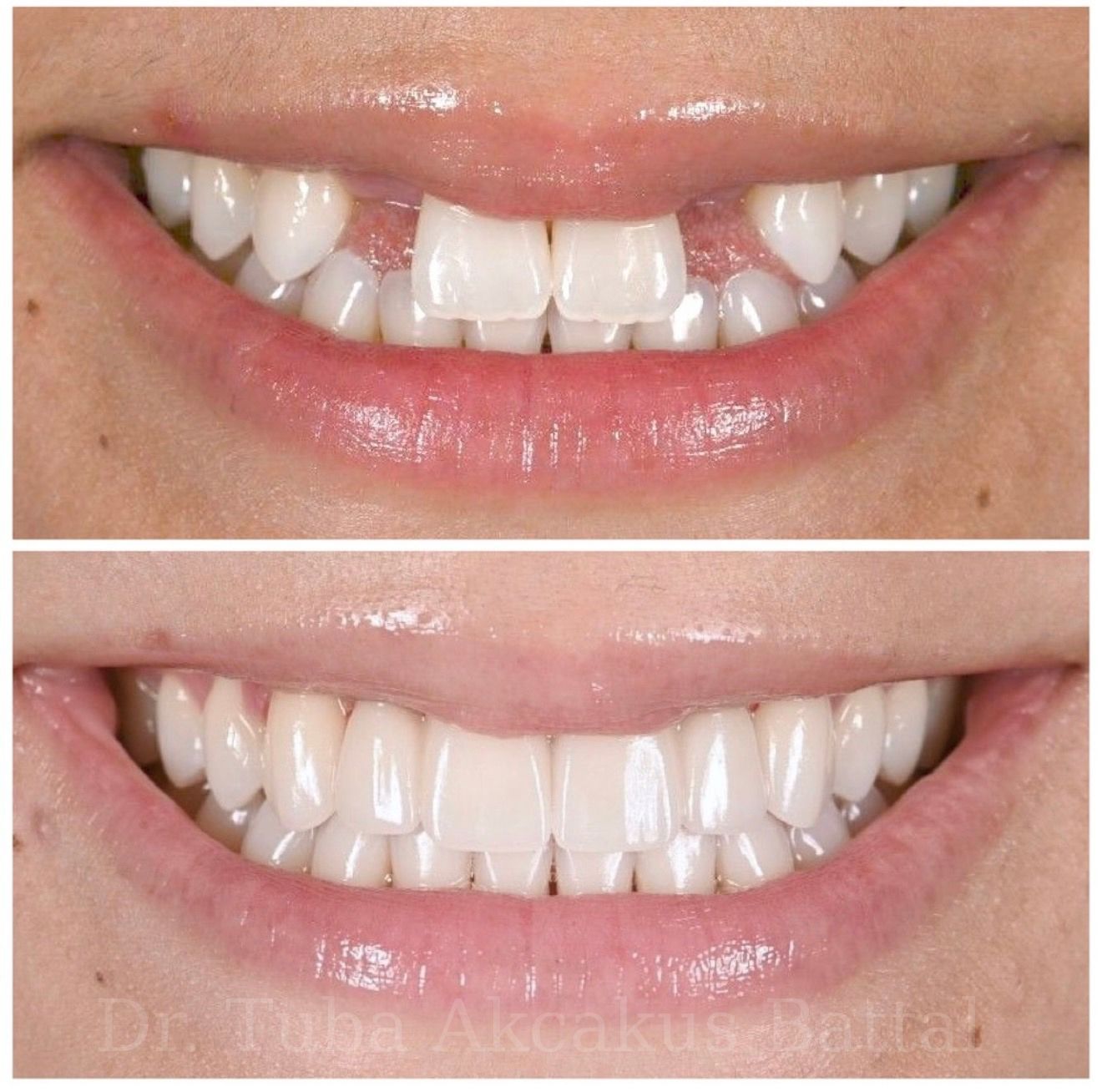
Dental implant result — single tooth restored with zirconium crown
The Surgical Procedure Step by Step
Modern dental implant surgery follows a well-established protocol designed to minimise risk and maximise osseointegration predictability.
- CBCT planning: A cone-beam computed tomography scan provides three-dimensional mapping of bone volume, density, and the positions of vital structures (inferior alveolar nerve, mental foramen, maxillary sinus). Digital planning software allows the precise virtual positioning of implants before surgery.
- Surgical guide fabrication: A custom surgical guide, manufactured from the digital plan, is used intraoperatively to direct the implant drill to the exact pre-planned position and angulation.
- Fixture placement: Under local anaesthesia, a mucoperiosteal flap is raised (or a flapless approach taken where anatomy permits), the osteotomy is prepared with a graduated series of drills, and the implant fixture is inserted to the planned depth and angulation.
- Healing phase: The implant is left to integrate for 3–6 months (shorter in denser bone, longer in softer bone or augmented sites). A healing abutment or cover screw maintains gingival contour during this period.
- Abutment connection and crown delivery: Once osseointegration is confirmed radiographically, the abutment is connected, an impression or digital scan is taken, and the definitive crown is fabricated and delivered.
Implant Materials: Grade IV Titanium and Zirconia Implants
The vast majority of dental implants are fabricated from Grade IV commercially pure (cp) titanium or Grade V titanium alloy (Ti-6Al-4V). Both materials offer outstanding biocompatibility — titanium forms a stable titanium dioxide (TiO₂) oxide layer on its surface that inhibits corrosion and promotes osteoblast adhesion. Grade IV cp titanium is slightly more ductile; Grade V alloy offers higher strength for narrower-diameter implants in sites with limited bone width. Zirconia (Y-TZP) implants are an emerging metal-free alternative for patients with documented titanium sensitivity or who prefer a tooth-coloured subgingival fixture; however, their long-term evidence base is not yet as extensive as that for titanium.
Are You a Suitable Candidate?
Dental implant candidacy is determined by a combination of local and systemic factors assessed at your initial consultation.
- Bone volume: Sufficient bone height and width at the implant site is essential. Where bone is deficient, guided bone regeneration (GBR) using resorbable membranes and xenograft or allograft materials can rebuild it before or concurrent with implant placement.
- Systemic health: Well-controlled systemic conditions are generally compatible with implant placement. Uncontrolled diabetes, bisphosphonate therapy (particularly intravenous), and prior jaw radiotherapy are the main contraindications requiring specialist evaluation.
- Smoking: Smoking significantly increases the risk of peri-implantitis and implant failure. Perioperative cessation is strongly recommended; ideally, patients should quit entirely.
- Age: Implants are not placed until jaw growth is complete, typically after 18 years of age for most patients.
- Oral health baseline: Active periodontal disease and untreated caries must be resolved before implant placement to minimise infection risk.
Frequently Asked Questions
Does implant surgery hurt?
Implant surgery is performed under local anaesthesia and is not painful during the procedure. Patients typically feel pressure and vibration but not pain. Post-operative discomfort is mild to moderate and well managed with over-the-counter analgesics (ibuprofen and paracetamol) for most patients. The vast majority describe it as less uncomfortable than they had anticipated. Sedation is available for particularly anxious patients.
How long do dental implants last?
The titanium implant fixture, once fully osseointegrated, can remain functional for life in the vast majority of patients with good oral hygiene and regular professional maintenance. Systematic reviews consistently report 10-year implant survival rates above 95%. The prosthetic crown on top of the implant will likely need renewal at some point — typically after 15–20 years — due to normal wear, though this is a routine procedure that does not affect the implant itself.
What happens if my bone is insufficient for an implant?
Insufficient bone is one of the most common challenges in implant dentistry, but it is usually manageable. Guided bone regeneration (GBR) uses barrier membranes and bone substitute materials to regenerate lost volume. Socket preservation at the time of tooth extraction prevents ridge collapse. Sinus floor elevation increases bone height in the posterior upper jaw. In severe cases, block bone grafting using autogenous bone may be required. These procedures add time and cost to the overall treatment but dramatically expand who can benefit from implants.
What does a dental implant cost in the UK vs Turkey?
A single dental implant including the crown in the UK typically costs between £2,000 and £3,500. In Antalya, the same quality implant and crown — using premium brands such as Nobel Biocare or Straumann — is available at 50–60% of typical UK pricing, without compromising clinical standards or materials. For patients requiring multiple implants, the savings are proportionally greater. Our team provides detailed, transparent cost estimates at the initial consultation stage.

Natural aesthetics restored with implant-supported crowns