Among all clinical practitioners who administer botulinum toxin, dentists occupy a uniquely informed position. Dental training encompasses the most exhaustive study of trigeminal nerve branch anatomy, masticatory muscle architecture, and occlusal biomechanics of any healthcare discipline — precisely the anatomical territory in which facial Botox injections are placed. UK GDC-registered dentists are legally permitted to administer botulinum toxin for dental and facial indications, and as a prosthodontist, I integrate Botox treatment within a holistic view of bite function, jaw mechanics, and smile design. This is not Botox administered in isolation — it is Botox considered alongside how your teeth occlude, how your jaw muscles load, and how the result harmonises with your overall facial and dental aesthetic.
The indications I treat fall into two categories. Therapeutic: bruxism (teeth grinding and clenching), TMJ myofascial pain, and gummy smile caused by hyperactive lip elevator muscles. Aesthetic: masseter reduction for facial slimming and jawline softening — which, in bruxist patients, delivers therapeutic and aesthetic benefit simultaneously. Every patient undergoes a thorough clinical assessment before treatment, and Botox is always discussed in the context of any concurrent prosthodontic care.
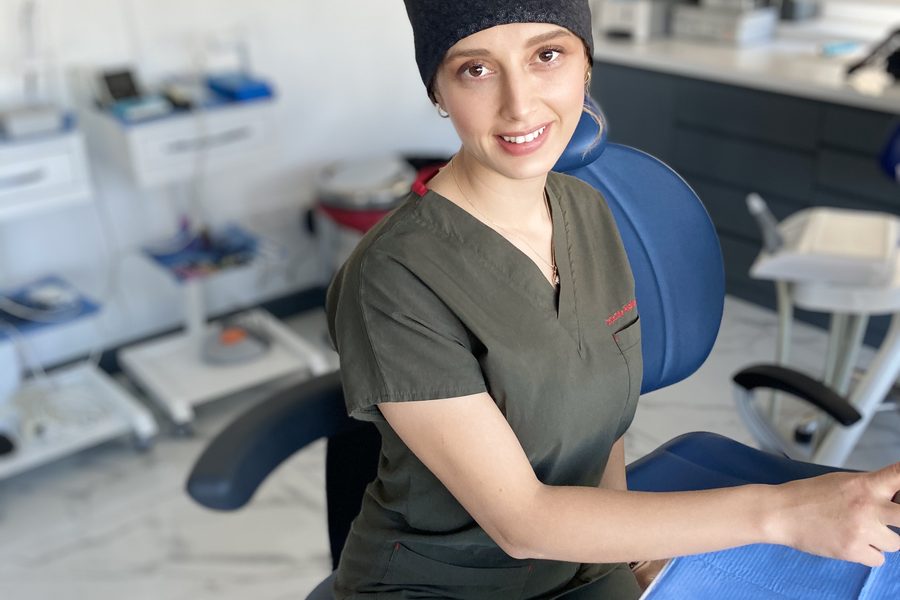
Dental Botox consultation — Dr. Dt. Tuba Akcakus Battal
How Botulinum Toxin Works
Botulinum toxin type A is a purified protein derived from Clostridium botulinum that acts at the neuromuscular junction by inhibiting presynaptic release of acetylcholine — the neurotransmitter that signals muscle contraction. When acetylcholine cannot be released in sufficient quantity, the targeted muscle is unable to contract fully, resulting in a controlled, localised reduction in muscle activity. The effect is not immediate: onset develops progressively over 3–14 days as the toxin integrates at the neuromuscular junction and the existing acetylcholine supply is depleted. Full effect is typically reached by day 14.
Duration of action is 3–6 months. During this period the neuromuscular junction gradually regenerates — new terminal axon sprouts restore acetylcholine release capacity and normal muscle function progressively returns. There is no permanent structural change to the nerve or muscle at clinical doses. The three principal commercial preparations available in the UK are Allergan BOTOX (onabotulinumtoxinA), Galderma Dysport (abobotulinumtoxinA), and Merz Xeomin (incobotulinumtoxinA) — each measured in their own unit systems, which are not interchangeable. Dosing is therefore individualised to the product used, the muscle targeted, and the clinical indication.
Botulinum toxin has been in continuous clinical use for more than 30 years. The FDA approved it for therapeutic indications beginning in 1989 (strabismus, blepharospasm), with subsequent approvals for cervical dystonia, hyperhidrosis, chronic migraine, and overactive bladder. Its safety profile at clinical doses is well established: there is no systemic toxicity, no accumulation in the body, and the mechanism of action — inhibition of acetylcholine at the neuromuscular junction — is reversible in all cases.
Bruxism Treatment with Botox
How Bruxism Damages Teeth and Joints
Bruxism — the habitual clenching and grinding of teeth, most commonly during sleep — generates bite forces 6–10 times greater than those produced during normal chewing. Where normal masticatory forces peak at approximately 80–120 N on posterior teeth, bruxist grinding forces routinely exceed 400–600 N, sustained over extended nocturnal episodes. The consequences are progressive and cumulative: enamel attrition flattens and shortens anterior teeth, posterior cusp tips fracture, existing restorations chip or debond, and implant prosthetics — particularly fixed bridges — are placed under fatigue stresses that can lead to screw fracture or prosthetic component failure. Chronically elevated loading also stresses the temporomandibular joint, contributing to articular disc displacement, capsular inflammation, and myofascial pain throughout the masticatory musculature. Masseter and temporalis hypertrophy — the overdevelopment of jaw muscles in response to sustained high-force use — commonly accompanies bruxism and is both a consequence of and a contributor to the parafunctional cycle.
Masseter Botox Injection
The therapeutic injection of botulinum toxin into the masseter muscle targets the primary driver of nocturnal grinding force. A dose of typically 25–50 units of BOTOX (or equivalent in Dysport/Xeomin units) is administered per masseter using a fine-gauge needle, with injection points positioned in the mid-belly of the muscle to achieve broad effect while avoiding superficial structures. The result is a 30–60% reduction in maximum bite force, a significant decrease in the frequency and intensity of nocturnal bruxism episodes as measured by electromyography in controlled studies, and meaningful protection of the dentition and any prosthetic work. Masseter Botox complements — and does not replace — an occlusal splint (nightguard), which distributes residual forces and provides a physical barrier between the arches. The combination of Botox and splint therapy has stronger clinical evidence for bruxism management than either intervention alone.
Duration and Maintenance
The therapeutic effect of masseter Botox for bruxism lasts 3–6 months, after which the neuromuscular junction recovers and muscle activity gradually returns to baseline. Repeat injection is required to maintain benefit. Importantly, patients who receive multiple sequential treatment cycles over one to two years frequently demonstrate sustained reduction in masseter hypertrophy even between sessions — the muscle atrophies progressively with repeated cycles of reduced use, and some patients find that maintenance intervals can be extended over time. This progressive reduction in muscle bulk also confers the aesthetic benefit of a slimmer, softer lower facial contour.

Clinical precision — specialist injection technique
TMJ Pain Relief
Temporomandibular disorders (TMD) encompass a broad spectrum of conditions affecting the temporomandibular joint, masticatory muscles, and associated structures. The myofascial subtype — in which pain arises from trigger points within the masseter, temporalis, and medial pterygoid muscles — is particularly responsive to botulinum toxin. Injection of 15–25 units per trigger point directly into hyperirritable loci within these muscles reduces the afferent pain signal, interrupts the pain-spasm-pain cycle, and decreases the referred pain patterns that characterise myofascial TMD: temple headaches, ear pain, cheek tenderness, and neck pain. For more complex TMD presentations involving disc displacement or joint capsule involvement, lateral pterygoid injection is an advanced technique that can reduce the lateral deviation and pain associated with anterior disc displacement — though this requires precise anatomical knowledge and clinical experience with this deeply situated muscle.
The combination of Botox with an occlusal splint for TMD management has the strongest evidence base of any non-surgical approach. A well-fitted splint addresses the occlusal loading component while Botox reduces the muscular hyperactivity component — together they provide superior pain relief and functional improvement compared with either intervention alone. For a full discussion of TMJ disorders and their management, see our TMJ disorders page.
Gummy Smile Correction
A gummy smile — technically termed excessive gingival display — occurs when the upper lip elevates too far on smiling, exposing more than 3–4mm of gingival tissue above the upper incisor margins. In many cases, the underlying cause is hyperactivity of the levator labii superioris alaeque nasi (LLSAN) and/or the levator labii superioris (LLS) — the muscles responsible for elevating the upper lip during the smile. Botulinum toxin injection at the alar base (the junction of the nostril and cheek), typically 2–4 units per side into the LLSAN, gently reduces the muscle's peak contraction during smiling without affecting lip movement at rest. The result is a natural-looking smile in which the gum line is lowered by 3–5mm, eliminating or substantially reducing the gingival display. Effect onset is 3–5 days and duration is 3–4 months — slightly shorter than masseter injections, as the perioral muscles are smaller and the dose lower.
For patients seeking a more permanent resolution of gummy smile, surgical lip repositioning — in which the mucogingival attachment is repositioned to permanently limit upper lip elevation — is an alternative that I can discuss and refer for. Botox correction of gummy smile also integrates naturally with veneer or composite bonding treatment: where a smile makeover is planned, Botox ensures the final aesthetic is evaluated with the gum line correctly positioned, preventing over-engineering of the ceramic work to compensate for excessive gingival display. See our porcelain veneers and composite bonding pages for more on smile design.
Facial Contouring (Masseter Reduction)
Beyond its therapeutic application in bruxism, masseter botulinum toxin is a well-established aesthetic treatment for patients with masseter hypertrophy who wish to achieve a slimmer, more oval lower facial contour. In patients with overdeveloped masseter muscles — whether from bruxism, habitual gum chewing, or genetic predisposition — the lower face appears wide and square when viewed from the front, with pronounced muscle bulk visible at the angle of the jaw. Injection of 25–50 units per masseter initiates a gradual atrophic process in the muscle: over 6–8 weeks, the masseter diminishes in bulk as the reduced level of contractile activity leads to progressive muscle fibre thinning. The resulting facial change is a softer, more tapered jawline with a less prominent mandibular angle — a change that becomes progressively more pronounced with repeated treatment cycles. In bruxist patients, this aesthetic benefit is delivered simultaneously with the therapeutic reduction in nocturnal grinding force, making masseter Botox one of the most clinically efficient interventions in the dental-aesthetic toolkit.
Safety and What to Expect
Before any Botox treatment, every patient undergoes a thorough medical history review and contraindication screening. Absolute contraindications include pregnancy and breastfeeding (botulinum toxin is not administered during either), pre-existing neuromuscular diseases such as myasthenia gravis (MG), amyotrophic lateral sclerosis (ALS), or Lambert-Eaton myasthenic syndrome, in which any further reduction in neuromuscular transmission is hazardous, and concurrent use of aminoglycoside antibiotics (gentamicin, streptomycin), which potentiate the effect of botulinum toxin unpredictably. Patients on anticoagulant therapy should disclose this as bruising risk is increased, though this is not an absolute contraindication.
The procedure itself is brief — 10–20 minutes depending on the number of injection sites — and performed with a fine-gauge (30–32G) needle, which minimises discomfort. Most patients describe the sensation as a mild pinprick. Topical anaesthetic cream can be applied if requested. No sedation is required. Following injection, patients should avoid rubbing the injection sites for four hours and remain upright for four hours, to prevent product migration to adjacent muscle groups. Strenuous physical exercise should be avoided for 24 hours. A review appointment at two weeks allows assessment of the degree of effect and any minor touch-up injection if indicated.
Possible side effects include mild bruising or localised swelling at the injection site, which typically resolves within 2–3 days, and a transient mild headache on the day of treatment. Temporary mild weakness of adjacent muscles may occur in rare cases if product migrates from the injection site — for example, slight ptosis (eyelid drooping) if product placed in the upper face migrates to the levator palpebrae, or mild difficulty chewing very tough foods in the first weeks after masseter injection. These effects resolve spontaneously as the product is metabolised. There is no downtime from work or normal activities.
Clinical Evidence
The evidence base for botulinum toxin in dentistry spans several distinct applications. For sleep bruxism, a randomized placebo-controlled trial by Shim et al. (2020) found that masseter BoNT-A injection significantly reduced the peak amplitude of nocturnal EMG bursts for up to 12 weeks compared to saline — a measurable reduction in muscle activity, though a single injection does not eliminate the underlying bruxism trigger. For myofascial TMJ pain, the double-blind crossover trial by Ernberg et al. (2011), published in Pain, demonstrated meaningful reductions in resting pain intensity following BTX-A injection in patients with persistent myofascial TMD unresponsive to conventional treatment. For facial contouring, a systematic review by Rauso et al. (2022) analysing 28 studies and 748 patients reported a 26–31% reduction in masseter muscle thickness at three months — the biological basis for the jawline-slimming effect described above. As with all botulinum toxin applications, results are temporary (typically 3–6 months) and depend on accurate dosing and injection-site selection by an experienced clinician.
Frequently Asked Questions
Is dental Botox safe long-term?
Yes; botulinum toxin has a well-established safety profile developed over more than 30 years of therapeutic and cosmetic use. Effects are fully reversible — the neuromuscular junction regenerates between treatment cycles and the muscle recovers normal function. No systemic accumulation occurs at clinical doses, and no permanent changes to nerve or muscle structure result from repeated treatment at appropriate intervals. Long-term users of masseter Botox typically observe progressive reduction in muscle bulk over years of treatment, which is a desired therapeutic and aesthetic outcome rather than an adverse effect.
How often do I need Botox for bruxism?
Typically every 3–6 months to maintain full therapeutic benefit, as this corresponds to the duration of action of botulinum toxin in the masseter muscle. Some patients report a sustained reduction in grinding severity and masseter volume after several treatment cycles — as the muscle atrophies progressively, some find that maintenance intervals can be extended to 5–7 months over time. Clinical assessment at each visit determines whether the effect has adequately carried through or whether re-treatment is indicated earlier.
Will Botox stop my bruxism permanently?
Botox significantly reduces the intensity and frequency of bruxism episodes but does not permanently eliminate the behaviour, as it does not address the underlying neurological or psychological drivers of the parafunctional habit. It is most effectively used as part of a comprehensive management plan that includes a well-fitted occlusal splint to protect the dentition during the periods between injections, and — where stress or anxiety is identified as a contributing factor — appropriate behavioural or psychological support. Some patients achieve excellent long-term control of their bruxism through the combined Botox-and-splint approach maintained over years.
What does dental Botox cost in the UK vs Antalya?
In the UK, masseter botulinum toxin injections for bruxism or TMJ typically cost £250–£500 per session depending on the dose and the number of muscles treated; gummy smile correction costs £150–£300. In Antalya, specialist dental Botox treatments using the same pharmaceutical-grade products — Allergan BOTOX, Dysport, or Xeomin — are available at 35–50% of UK prices. For patients combining Botox with prosthodontic treatment (implants, veneers, crowns), scheduling the Botox consultation at the same visit significantly reduces the overall travel cost.

Natural smile aesthetics — gummy smile correction and smile design